How to Find Your Personal Style Without Starting Over
Use outfits you already wear to notice your preferences and test a personal style direction, one practical choice at a time.
Start with an outfit you have actually worn and would happily wear again. Put the whole combination together, shoes and bag included, and choose one detail you like about it. Perhaps the top sits away from your body, the colors feel calm, or the shoes let you get through the day as planned. That detail gives you something to test the next time you get dressed.
If you're wondering how to find your personal style, that is a useful place to begin: observe a choice you've already made, then try a small variation in your own life. You don't need a replacement wardrobe or a permanent aesthetic label. A direction can be as practical as wanting uncomplicated outfits with an occasional bit of pattern.
Begin with a complete outfit
Think of a recent day when you liked what you wore. What were you doing, and which parts of the outfit earned their place? Look beyond the garment category. A shirt might appeal because of its open neckline, its color, the way its sleeves sit, or because it works with a favorite pair of trousers. The answer can be particular to that shirt.
Include the parts you might overlook. A bag that holds what you need or shoes you choose for a long walk can influence the clothes around them. Notice whether you liked the finished combination, too. An appealing top on its own may feel quite different once you add the layer and shoes you need for the day.
If several aesthetics appeal to you, leave their names aside for a moment. Pick one complete outfit you've worn and describe what you liked about it in its actual setting. You may find details from different looks useful at different times. A preference doesn't have to pass an audition for a single category.
| Starting point | A useful decision |
|---|---|
| An outfit you already repeat | Identify a detail you like and compare it with an owned alternative. |
| An admired detail to test | Borrow one idea from an image and try it with a familiar outfit. |
| A preference that changes by occasion | Keep the choices that work in each setting, even if they look different. |
Notice what a repeat outfit tells you
Imagine a reader who often chooses a plain navy top, familiar trousers, flat shoes and a practical bag for a day of errands and appointments. She likes the top's simple neckline and the uninterrupted color with her trousers. The bag has room for what she needs, while the shoes are her usual choice for that particular route.
She might conclude that she enjoys a fairly quiet base for busy days. That observation is more useful than declaring herself a classic dresser forever: it gives her a detail to compare with something she already owns. Suppose she has another top with the same easy neckline but a small print. She can wear it with the same trousers, shoes and bag on a similar day and see whether she enjoys the extra visual detail.
If the print feels distracting, she can return to the navy top and keep the plain base as a preference for that kind of day. If she likes it, the print can join the rotation. Perhaps she likes the print but finds the alternative top awkward when reaching or sitting; in that case, the result concerns the cut as well as the pattern. Changing one piece makes it easier to tell what she is responding to.
If you don't own a suitable alternative, there is no need to manufacture a comparison. Note what you like about the outfit you have, and return to the question when another choice is available.
Separate an image you admire from a detail you'll wear
An image can be lovely because of its setting, lighting or the way a whole look has been arranged. Those conditions may have little in common with your day. Before trying to recreate the outfit, ask which detail catches your attention: a print near the face, a loose layer, a contrast between polished and relaxed pieces? Choose one detail you can try with something you already have.
Consider a second hypothetical reader who saves images of patterned clothes but usually reaches for a simple dress, her preferred shoes and a bag that suits her plans. She is curious about the pattern, though she has no reason to assume she wants a whole patterned outfit. She owns a printed scarf, so she adds it to that complete dress outfit for an ordinary outing.
She can check whether the scarf stays where she wants it and whether she likes seeing the print alongside the dress throughout the day. If she enjoys the color but finds the scarf inconvenient, she might tie it to the bag instead, provided that works for how she uses the bag. If she prefers the dress without it, the image can remain a pleasure to look at. Neither result calls for buying the photographed look.
The same approach works when an admired detail is unavailable in your closet: describe it, then wait for a useful opportunity to compare it with what you wear. Admiration is information, not an instruction to shop.

Allow for different occasions
One person's preferences can change with the setting. Imagine a reader who likes a simple top and trousers with flat shoes and a roomy bag during the day. For an occasional gathering, that same reader prefers a more decorative dress with her chosen shoes and a small bag that holds what she needs for the evening.
The daytime outfit suits the activities she expects to do; the dress gives her the amount of decoration she wants for the gathering. There is no contradiction to solve. If the gathering involves more walking than expected, she can try the dress with the flatter shoes she already owns. If those shoes don't make the combination feel right to her, she can choose another available pair or another outfit.
Compare your own choices across two real uses before turning a preference into a rule. You may like a restrained outfit for one setting and a decorative one for another. A few optional notes can capture that distinction, and you can change them as your circumstances or tastes change.
When your closet belongs to an earlier chapter
Clothes from a former job or an earlier taste can make your current preferences harder to read. Start with one item you still like in some way. Perhaps an old work shirt has a neckline you enjoy, even though you no longer want to wear it with the matching formal trousers. Try it with trousers you already reach for and your usual shoes. Leaving the shirt open over an owned top is another reversible change, if that combination suits the occasion.
Notice what you want to keep from the old outfit and what feels tied to a role you no longer dress for. You may discover that you lack a piece needed to test an idea properly. It is fine to leave that question open; you don't have to discard the old clothes or buy something to settle it today.
Choose your next test
Pick an upcoming day and assemble the entire outfit you expect to wear, including the shoes, bag and any layer you will need. If you have an owned alternative you want to compare, put together that complete version too. Check that the pieces are available, then sit, reach and move as you expect to during the day.
Afterward, make a brief note if you like: which detail would you repeat, and what would you change next time? A useful answer might be as small as keeping the plain top for a busy day and saving the printed scarf for an outing where it won't get in the way. Your notes can remain observations, not a set of rules.
For broader wardrobe planning, the Capsule Wardrobe plan covers editing, fitting and wearing clothes, alongside a buying phase.
I hope your next outfit gives you a detail worth keeping.
With love,
Margot
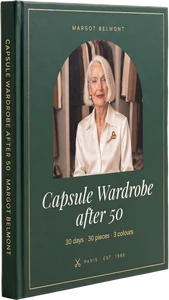
Get dressed in five minutes. 30 days, 30 pieces, 60 outfits on me. PDF workbook · 97 pages · 6 printables.
See inside — $29
I’ve seen every trend twice, darling. Forty years in a Paris atelier, three little guides. More about Margot →
© 2026 margotbelmont.com. This article and its photos are protected by copyright. You are welcome to share a link to it or pin an image that links back here. Please don’t copy, republish or adapt the text or photos, or use them for AI training, without our written permission. Terms