How to Choose a Wardrobe Color Palette From Clothes You Own
Build a useful clothing color palette from favorite pieces, then test outfits and alternatives without starting a shopping list.
A useful wardrobe palette is a short record of colors you enjoy wearing together, grounded in clothes you already reach for. It can help you see why some pieces have several partners while others need a little more thought. It does not require a fixed number of colors, a capsule wardrobe, or a fresh collection of matching hangers.
Start with the outfits you wear for your actual days. A palette built around a beautiful jacket you never have an occasion to wear may be lovely on paper and less useful on a Tuesday morning.
Start with worn favorites
Pull out a small selection of clothes you have worn and liked for the things you regularly do. Include a few pieces that make an outfit easier to assemble and one or two you particularly enjoy. Lay them together in the same light, or hang them side by side where you can see the colors clearly.
Look for relationships rather than a perfect match. Which trousers work with more than one top you like? Does a cardigan sit comfortably with several pieces, visually and in the way you want to dress? A color may appear often in your closet yet tell you very little if those garments stay unworn. Give more weight to the pieces you choose for a real occasion.
Write down the garments as well as the colors: "soft navy trousers" is a more useful note than "blue." You can add the shade and any detail that helps you find the item again, such as a green-and-cream patterned skirt. The note is a record of choices, not a shopping specification.
Give colors a job
A base is a color you choose to repeat across outfits because it has partners you like. An accent is a color you use when you want a smaller or occasional change. A print can bring several colors into one piece and suggest partners elsewhere. These are roles you assign, not permanent classifications: a bright green could be a base in one wardrobe and an accent in another.
Repeating a base can make it easier to reuse a cardigan or pair of trousers across outfits. You might prefer several small groups of clothes instead. Neither approach requires every top to go with every bottom. A print can suggest a top in one of its colors, but there is no need to match every hue in the pattern.
Here are two hypothetical ways to record different preferences:
| Starting point | Palette decision |
|---|---|
| A base-led palette | Repeat navy; use ivory as a light partner and berry when wanted. |
| A print-led palette | Start with a green-and-cream skirt; test green and other plain tops against it. |
When a repeated base helps
Imagine someone who wears navy trousers often and likes the way a navy cardigan works with them. For an ordinary day, she puts those pieces with an ivory top, shoes suitable for her plans and her everyday bag. A berry scarf is there if she wants the accent. Navy earns its place as a base because those particular garments have a combination she is willing to wear.
For another outfit, she tries an owned berry top in place of the ivory top and scarf, keeping the trousers and cardigan. If she likes the combination and the shoes and bag suit the day, she can record it as a second option. If the two navy pieces look too different together for her taste, she can try the cardigan with another bottom or wear the trousers with a different layer. The label "navy" alone cannot make that decision for her.
Ivory and berry are choices in this example, not required companions to navy. The shoe and bag colors can sit outside the note. What confirms the combination is useful is seeing the actual outfit together and choosing it for the intended occasion, not counting how many palette colors it contains.
When a print leads the way
Now imagine someone whose favorite starting point is a green-and-cream patterned skirt. She likes color and wants the skirt to stay prominent. She tries it with an owned plain green top, personally suitable flats and her usual bag, adding a cream cardigan if she wants a layer. The green top picks up a color in the print; the cardigan is an option rather than a condition.
For an alternative, she places another plain top she owns beside the skirt, even if it is not an exact match for any color in the pattern. She compares both combinations in the same light and chooses the one she prefers for the day. The second top might give the skirt another useful partner without adding another printed item.
She can record the skirt as the starting piece and note the tops she likes with it. There is no need to extract every color from its print or fit her shoes and bag into a quota. A bright color can do the repeating work that navy does in the first example; neutrals and a particular metal are optional.
Handle the awkward almost-matches
Two garments with the same color name may look different side by side. Lay them together and decide whether you enjoy the difference. You might like the deliberate tonal effect, prefer to separate them into different outfits, or find another owned layer that makes the combination feel right to you. An exact match is one option, not a test every outfit must pass.
The same approach works for black and navy. Put the actual pieces together with the rest of the outfit and look at them in the light where you are comparing your clothes. If you like them together, wear them. If you do not, give each a different partner. There is no universal ban to consult.
A loved garment can also sit outside your everyday palette. An occasion dress, for example, may need only its own shoes and bag. Keep it as a small separate set if that is how you wear it; there is no reason to rebuild the rest of your closet around it.
Test outfits before identifying a gap
Choose one combination from your notes and put the whole outfit together, including the shoes, layer and bag you would use. Try an alternate top or bottom from what you own. A color pairing may look appealing on hangers but feel less like the outfit you had in mind once the full combination is assembled. Note the difference: perhaps the layer is too visually busy for your preference, or you would rather wear another pair of shoes.
If a combination seems to need a different piece, try owned substitutes first. A cardigan in another color, a different bag or an outfit built around the same skirt without the original top may answer the problem. Only after that is it useful to write down a specific missing connection, such as a layer you would want with two outfits you already wear. A note is not an obligation to buy it.
New colors are optional, and there is no need to replace clothes just to make every shade match. Keep the combinations that serve you and leave the others alone.
Make a note you can use
For your next closet session, write a short palette note with the exact garments, the color roles you have chosen and one complete outfit. Add an alternate made from another owned piece, then check both with your shoes, layer and bag. Record one adjustment you want to try next time.
Return to the note when your activities or preferences change. It can change with them; it does not need to follow a rule about your age.
For a broader approach to editing, fitting and wearing the clothes you own, the Capsule Wardrobe plan includes Edit, Tailor, Buy and Wear phases.
I hope your next combination makes an old favorite easy to wear again.
With love,
Margot
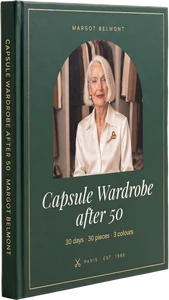
Get dressed in five minutes. 30 days, 30 pieces, 60 outfits on me. PDF workbook · 97 pages · 6 printables.
See inside — $29
I’ve seen every trend twice, darling. Forty years in a Paris atelier, three little guides. More about Margot →
© 2026 margotbelmont.com. This article and its photos are protected by copyright. You are welcome to share a link to it or pin an image that links back here. Please don’t copy, republish or adapt the text or photos, or use them for AI training, without our written permission. Terms